
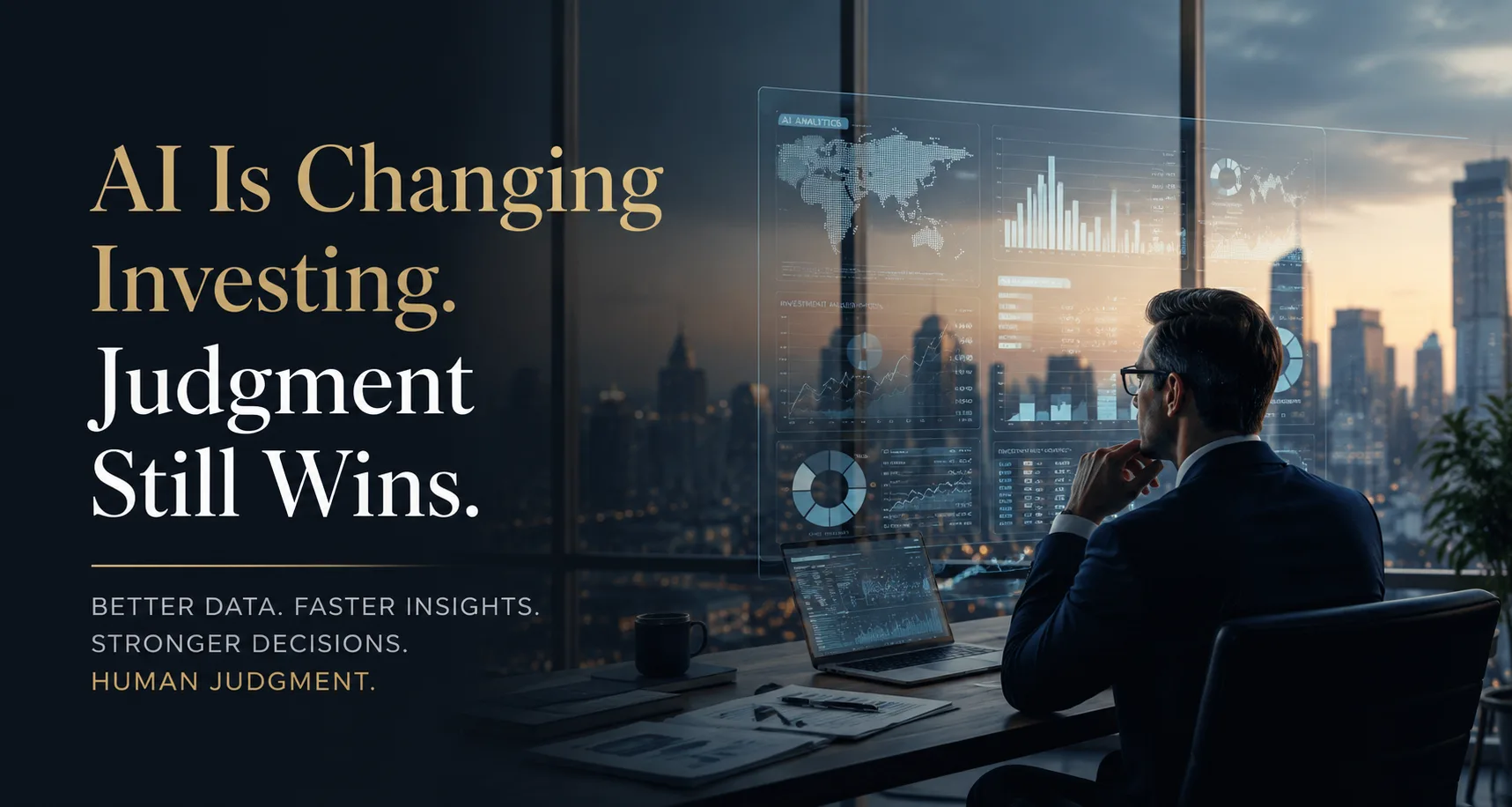
Artificial Intelligence has become the latest buzzword in the investment world. Today, it seems every second pitch deck claims to be AI-powered. Founders highlight it as a competitive advantage, while investors often treat it as a necessary checkbox during evaluation.
The real conversation, however, isn’t about whether a company uses AI. It’s about understanding what AI genuinely contributes to investment decision-making—and where its limitations begin.
Having advised clients through capital raises, strategic transactions and cross-border investments, I’ve seen firsthand how AI is reshaping the way opportunities are evaluated. Its ability to process vast amounts of information in minutes is remarkable. Financial statements, market trends, due diligence reports, competitive landscapes and scenario modelling can now be analysed at a speed that would have been unimaginable just a few years ago.
This has undoubtedly improved efficiency. Better data leads to better preparation, faster decision-making and, in many cases, fewer overlooked risks.
But investing has never been driven by data alone.
The most significant risks rarely appear in a spreadsheet. They emerge during conversations with founders, negotiations around a term sheet, interactions between management teams, or subtle inconsistencies that only become apparent through experience. AI can identify patterns, but it cannot assess intent. It cannot measure conviction, understand relationships or recognise the nuances that often determine whether an investment succeeds over the long term.
Particularly in cross-border transactions, trust remains one of the most valuable assets. Building confidence with promoters, understanding cultural dynamics and navigating complex negotiations require judgment that no algorithm can replicate.
This is where experience continues to matter.
AI should not be viewed as a replacement for thoughtful decision-making. It is a powerful analytical tool—one that enables investors to evaluate opportunities more efficiently, ask better questions and uncover insights faster than ever before.
The responsibility of making the final investment decision, however, still belongs to people.
The investors who will consistently outperform over the coming decade are unlikely to be those who rely entirely on artificial intelligence, nor those who ignore it altogether. They will be the ones who understand how to combine technological capability with human judgment, industry knowledge and disciplined decision-making.
Technology will continue to evolve.
Sound judgment, meaningful relationships and experience will remain timeless advantages.
As investors, perhaps the better question is not whether AI should influence our decisions—but how we can use it intelligently without allowing it to replace the instincts that have always protected capital.
How has AI influenced your own investment approach? Has it improved the quality of your decisions, or do you still find yourself relying on experience when it matters most?